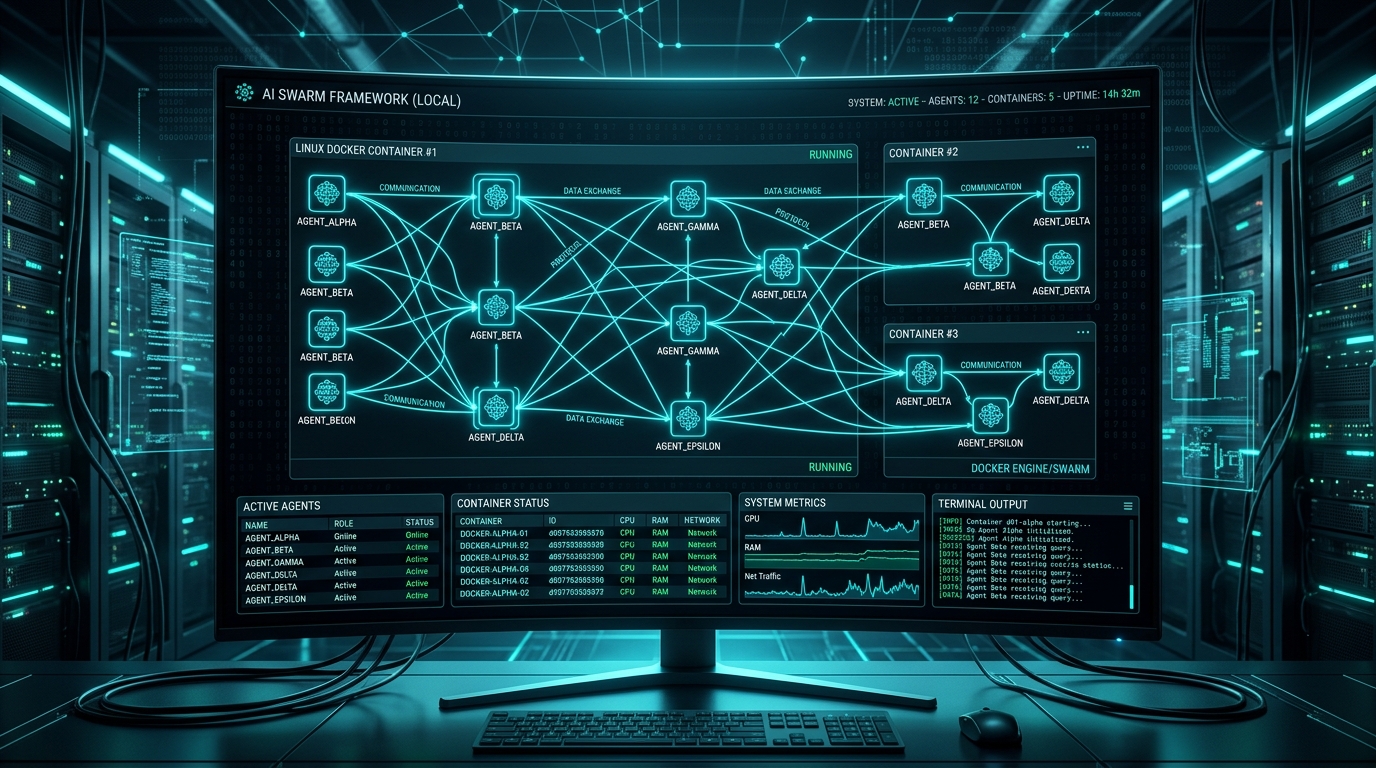
Building autonomous AI agents locally gives developers complete privacy, zero API costs, and full control over system capabilities. In this post, I detail how I orchestrate local multi-agent LLM swarms using Docker containers and Python.
1. Architecture Overview
Rather than relying on single monolithic prompts, modern AI systems divide complex tasks into specialized worker nodes:
- Planner Agent: Deconstructs developer tasks into actionable step-by-step sub-goals.
- Coder Agent: Writes, refactors, and inspects code within isolated environments.
- Reviewer Agent: Performs static analysis, checks edge cases, and verifies execution safety.
2. Local Docker Setup
We run local inference engines (like Ollama or vLLM) in lightweight Docker containers mapped to local host ports:
docker run -d --gpus=all \
  -v ollama:/root/.ollama \
  -p 11434:11434 \
  --name ollama-engine \
  ollama/ollama:latest
3. Python Multi-Agent Coordination
Using Python async workers, agents communicate over an event bus, passing JSON task definitions seamlessly.
Published by Roberto Ambrosio in AI & Autonomous Agents.